How to draw a stair easily

At the SketchUp Materials Library, there’s advice on how to draw a stair using the “multiple copies” feature: here.

Posted in Uncategorized | Comments Off on How to draw a stair easily

New satellite for imagery

NASA’s Landsat 8 satellite to launch on February 11

NASA is set to launch the Landsat 8 satellite [tomorrow], the latest in their ongoing Landsat Data Continuity Mission (LDCM). This launch is exciting as this will be one of the best image-capturing satellites in space, anticipated to collect over 400 images per day.  . . .” here, sample images

If all goes well, the images should begin to arrive from mid May 2013 onwards. When they will replace the earlier imagery in Google Earth is not yet announced.

Posted in Uncategorized | Comments Off on New satellite for imagery

3D models on tablet devices

For various technical reasons, the SketchUp software cannot be ported onto portable touch-screen devices (except for laptop PCs with touch screens). However there are several ways of accessing the 3D Warehouse or transferring 3D models from SketchUp onto a tablet for presenting them interactively on its touch screen.

  • SightSpace 3D for Android platforms, Apple iPod, iPhone and iPad
  • Babel3D for iOS, Android and Apple iPad
  • NaviCad to view models from 3D  Warehouse on the iPhone
  • Also for iPhone/iPad: Cubits, Walkabout3D Mobile, 3DeeWarehouse, SimLab 3OBJ Viewer, 3DVIA Mobile, SketchBook® Pro.

Most of these applications are not just viewers but have various other capabilities: article

Posted in Uncategorized | Comments Off on 3D models on tablet devices

Managing complex models

It’s tempting to map out and develop a large model with lots of features, all on an equal basis. That approach is best suited to exploring shapes and relationships on a throw-away, prototyping basis. However the result is unlikely to be manageable to the end of the design phase. It does not anticipate the visualisation stage and will probably be hard to maintain, enhance or update.

Instead it’s usually best to work out what’s important to model in detail and keep the rest sketchy. A handy tutorial by a practitioner* Jim Leggitt gives crisp guidance on a structured approach to making a complex model manageable here.

*He is an architect, urban planner, professional illustrator, educator, writer and more besides. interview.

His pioneering speciality combines hand drawing with digital 3D modelling: like this.

Posted in Uncategorized | Comments Off on Managing complex models

‘Legacy’ 3D buildings in Google Earth

The latest version (7) of the Google Earth software has an option to display either the mass-produced building blocks or the hand-crafted (“legacy’) buildings.

Posted in Uncategorized | Comments Off on ‘Legacy’ 3D buildings in Google Earth

Town modelling: a Scouting example

In 2009, a scout Teddy Bogdanski III led residents of Madison, New Jersey, USA in a project for 3D modelling of their town centre:

  • “Taking a Scout Project to Another Dimension” hereoutcome

‘As for Mayor Holden, having her town appear in 3-D, she said, “could be not only a very useful planning tool, but one for marketing our downtown and boosting our tourism.”’

Many buildings are shaped yet none are photo-realistically rendered, which suggests that the 3D Warehouse was not used. From a scouting point of view though the condition was that the scout, Teddy Bogdanski, should demonstrrate leadership of the initial project in a monitored setting. Bodganski gained his Eagle Scout rating and a business award in June 2011: award

He stated “The mayor said that it saved the town $30,000 in consulting fees”.

Posted in Uncategorized | Comments Off on Town modelling: a Scouting example

First 3D model for Baldock

Take a look at the first 3D model in Google Earth of any building in Baldock, by LeeBoz: here

Posted in Uncategorized | Comments Off on First 3D model for Baldock

Cities in 3D

We – the modellers in the 3D_lgc network – have been uploading individual models to the 3D Warehouse, mostly for inclusion in Google Earth. That is all we need, unless someone comes up with a much larger set to upload. There is another means of uploading 3D models for use with 100 models or more at a time: “Cities in 3D”. guidance

Sets of 3D models submitted in this manner are published in Google Earth first, then in Google Maps and Google Maps for Mobile video.

By the way, Apple Maps include 3D city models: list.

Posted in Uncategorized | Comments Off on Cities in 3D

Funding opportunities

By the way, here are some relevant funding offers:

Funding to Stimulate 3d Printing

The Technology Strategy Board has launched a new £7 million competition to  stimulate innovation in; and overcome barriers to the take up of additive manufacturing (also known as 3D printing) and design.  By launching the competition, The Technology Strategy Board aims to accelerate the creation of new design, production and supply chain competences for UK businesses.  All proposals must be collaborative and business-led, involving at least one other non-academic partner. The Technology Strategy Board expect to invest between £50,000 and £750,000 in each project, although projects outside this range. The deadline for applicants to register is noon on the 23rd January 2013.”  here

Digital Makers Fund

“The Nominet Trust has launched a £225,000 Digital Makers Fund to support innovators with bright ideas for significantly increasing the number of young people who participate in making digital technologies such as websites, apps, hardware, games or brand new innovations.  The Fund is open to for-profit and private companies.  However funding will only be awarded for projects that have an identifiable public benefit related to the aims of the Fund and the Trust’s charitable objects. The Nominet Trust expect  to make a small number of grants between £20,000 and £50,000 alongside a package of tailored non-financial support.  The call is now open and initial expressions of interest will be accepted up until 17 January 2013.

Please note interested applicants will be required to attend a ‘digital makers’ workshop as part of the initial application process. In this first call we expect to make a small number of grants between £20,000 and £50,000, alongside a package of tailored non-financial support.  Grants will be awarded in March 2013.” here

Posted in Uncategorized | Comments Off on Funding opportunities

The future of 3D models in Google Earth

NOTE 1: Questions and comments are welcome, especially if you can add any latest information from authoritative sources such as from Google or Trimble.

NOTE 2: See the end of this post for a potential opportunity for Letchworth…

In June 2012 the Google Corporation announced that it would bring out a version of Google Earth to cater for for mobile phones and tablets. Incrementally, for major cities, the imagery would be sourced from aerial images taken at an angle and composed into three-dimensional imagery. That process has already started and will be applied incrementally around the world as aircraft overfly entire cities taking the photographs continually. This is only a gist for query and comment, as we interpret the plan. At the time of writing, there is no schedule and none is expected. For information, please refer to statements by Google such as here.

Why? A discussion as to why Google sold SketchUp to Trimble and started 45-degree aerial city modelling in bulk is here.

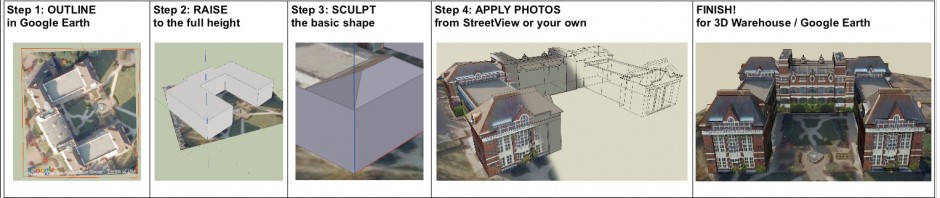
What is the big difference? The manual method using SketchUp or Building Maker added discrete models to the 3D Warehouse and thence to Google Earth, i.e. one 3D model for each building or complex. The new technology will apply a continuous “mesh” of structures to the terrain.

Will this apply only to accessing Google Earth via mobile devices? No, it will incrementally replace the content of Google Earth, regardless of how you access it.

Is this entirely new? No, aerial photography of cities and regions has been used for decades been used to visualise surface structures in various ways. What is new is the speed and extent of this initiative.

Will the 3D models in Google Earth be preserved? No, it will replace them wherever the”mesh” of 3D modelling covers the urban terrain.

Will our 3D models be wiped out? Apparently not anytime soon. As a world city, London would be an obvious candidate, as later on would Cambridge.

What will be the effect of the roll-out? Cities will increasingly have been modelled automatically whereas towns, villages and other settlements will only have the 3D models that have been modelled manually.

Will the contents of the 3D Warehouse also be replaced? No.

Will the resulting 3D mesh be as detailed as the manually modelled buildings? Generally, no. The automatic content is produced in bulk for reference; the manual models were crafted.

Will it be possible to insert 3D models into the new mesh of structures? No.

What about updating buildings and other structures to reflect changes? That will occur periodically but only in bulk.

What’s the “potential opportunity for Letchworth”? As Google envelops the world’s cities with 3D mesh, most town and other settlements will appear almost uninhabited for lack of 3D structures. So if Letchworth want this town to stand out from others, this is an opportunity for modelling features or parts of the town that will attract interest online. By the time Google’s automatic meshing process reaches here, the technological basis of the 3D mapping may have moved on beyond our present ken.
Posted in Uncategorized | Comments Off on The future of 3D models in Google Earth